

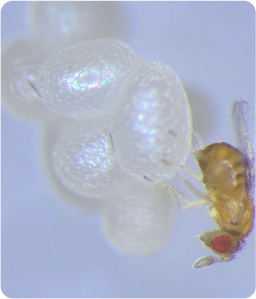
Foraging egg parasitoids benefit from the presence of potential competitors
During exploitative competition one individual doesn’t have access to a resource used by another. Interference competition is more subtle, as resource use by both competitors is inhibited. We found that the potential of interference competition when multiple egg parasitoids forage together increases the foraging efficiency of the wasps so that the overall rate of parasitism is high. This and other surprises Have just been published in Entomologia Experimentalis et Applicata: https://onlinelibrary.wiley.com/share/author/JEANTAXBSDPZ3MVA9Q3N?target=10.1111/eea.70120
More invasive than non-invasive Asteraceae plants can reproduce uniparentally
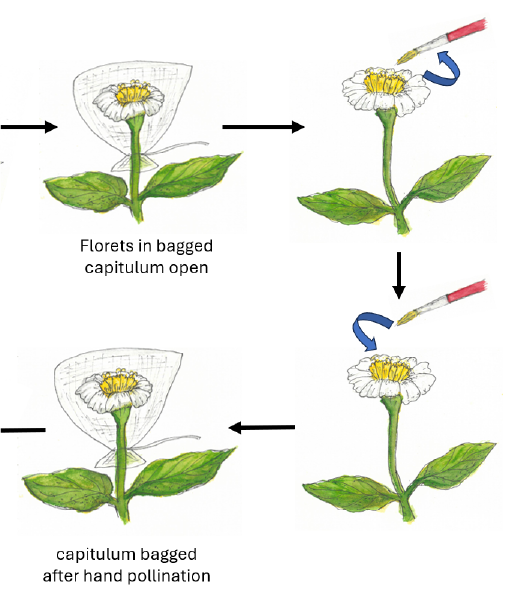
A plant that can reproduction on its own should be a better coloniser than one that needs a mate, because one individual can establish a persisting population. This advantage, called Baker’s law, can bias which species become invasive. Further, within predominantly biparentally reproducing species, this advantage can also lead to selection of individuals with uniparental reproduction during invasion. We show both these occurring among Asteraceae in India, in a study soon (2026) to be out in the journal Biological Invasions.

Special Feature in the Journal Ecological Applications: Applied Ecology in India (2025-26)
India covers a large area and contains a significant amount of the Earth’s biodiversity. It is home to the largest human population on Earth and also supports a rapidly growing economy. This special feature takes stock of the range and urgency of environmental challenges faced by India and brings to light some of the important and far-reaching applied ecological research being done there. Edited by S. van Nouhuys and S. Bagchi. See: https://esajournals.onlinelibrary.wiley.com/doi/toc/10.1002/(ISSN)1939-5582.applied-ecology-india